


Dive Site - J4 Submarine
| Dive Site - J4 Submarine | |||
| Dive Location: | City / Island: | ||
| J4 Submarine | The Heads, Bass Strait, VIC | ||
| Country: | Rating: | Max. Depth: | Difficulty: |
| Australia |  |
28 m | Advanced Open Water |
| Aquatic Name: | Water: | Altitude: | |
| - | Salt | 0 m | |
| GPS Latitude: | GPS Longitude: | GPS Datum: | |
| 38° 17.979′ S 38.29965° S 38° 17′ 58.74″ S |
144° 33.820′ E 144.563667° E 144° 33′ 49.2″ E |
Google Map | WGS84 |
| 13 dives at this location: | |||
| 34 | 68 | 89 | 94 | 109 | 142 | 143 | 154 | 199 | 278 | 281 | 320 | 359 | |||
| Map: | |||
 |
|||
| Comments: | |||
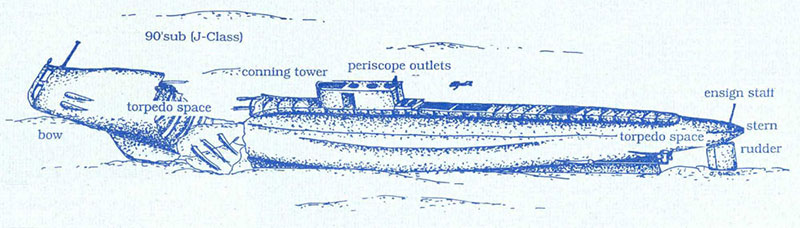
| The J4 Submarine (aka Shallow, 26 metre, 27 metre and 90 Foot Broken sub) is part of our very own piece of WWI maritime history, plus an exciting and awe-inspiring playground for divers and freedivers. The wreck of the J4 Submarine is located in the Victorian Ships' Graveyard, Bass Strait. It lies on its keel running North-South with its bow pointing out to sea on a rocky seabed. SCUBA DIVING AND FREEDIVING THE J4 SUBMARINE SHIPWRECK Entry/Exit: Boat. The stern of the J4 Submarine almost merges into the surrounding reef. (See also Sub Reef.) During its scuttling the bow section broke off, exposing the forward torpedoes tubes and bow modifications. This makes the torpedo tubes easily accessible to scuba divers without penetration. The conning tower is intact and in excellent condition. Scuba divers and freedivers can penetrate the submarine through the numerous hatch openings. Such penetration should not be taken lightly, as being shallower than the other subs, this wreck is particularly susceptible to surge. Unwary divers can be literally sucked in and catapulted through the wreck's interior. However, the surge prevents any silting, and under suitable conditions, this makes for one of Melbourne's top dives. Inside the J4 Submarine can very peaceful with streams of light peering in through the cracks and holes in the hull. Once inside, divers can see the bulkheads, which supported the submarine against pressure at great depths. Although the engine has been removed, the engine bed can still be seen at the stern. The broken bow section of the J4 Submarine contains four torpedo tubes, which can be easily seen by using a torch and positioning yourself between the bow and the main body. As with the other J-class submarines, the J4 Submarine is host to a variety of plant and animal life. Good conditions for photography are often found near the conning tower, which is usually surrounded by many fish. A bronze plaque has been placed on the conning tower by the Melbourne Bottom Scratchers Scuba Dive Club who rediscovered the submarine on 16 May 1982. The J4 Submarine is an excellent dive for Advanced Open Water divers. As this is a penetration dive, divers should be experienced, plus appropriately qualified and equipped. Some experienced freedivers have been known to descend down and through the J4 Submarine. The best part about the J4 Submarine is the relatively shallow depth. As a result, you can spend plenty of time exploring. You can easily penetrate the length of the submarine, plus spend time exploring outside. J4 SUBMARINE SHIPWRECK HISTORY Originally HMS J4, later HMAS J4, this is one of the J class submarines designed and built during WW1 by the British Royal Navy. The J class of submarines was a seven submarine class developed in response to claims that Germany was developing submarines that were fast enough - 22 knots (41 kpm) - to operate alongside surface fleets. The rumours were actually false. The J Class design brief was for a submarine to operate on the wings of battle fleets, diving at the commencement of engagements, and picking off stragglers, damaged ships, and acting as an anti-submarine submarine. This class of submarines were the only design of submarines ever to have had 3 screw propellers, and at the time were the fastest subs around with a surface speed of 19 knots (35 kpm). Six J class submarines were completed during mid-1916, while a seventh entered service in 1917. The HMS J4 submarine was commissioned in the Royal Navy on 17 July 1916 under the command of Lieutenant Commander DI McGillevie RN and was allocated to the 11th Submarine Flotilla based at Blyth, Northumberland. The wartime complement was 5 officers and 40 sailors. J4 SUBMARINE DETAILS Built in 1915/1916 at Portsmouth Naval Dockyard, England, launched on 2 February 1916 as a double-hulled type, triple screw submarine. At that time the J-class were the fastest subs in existence. It's commonly believed that the J-class submarines were identical in dimensions and layout, but this is not so. Royal Navy drawings placed the J-class into two groups of J1–J4 and J5–J7, and that the bridge of J7 was moved 60 feet aft compared to J5–J6. Plans show a difference in overall length between the two groups, with J5–J7 at 274 feet 9 inches being 9 inches shorter than J1–J4 which were 275 feet 6 inches. The overall length of the J4 Submarine was approximately 275.5 ft (84 m), beam 23.25 ft (7.09 m) and draught 16 ft (4.88 m) giving a displacement weight of 1,210 l-ton (1,229 t) surfaced and 1,820 l-ton (1,849 t) submerged. The J-class submarines were powered by three 12-cylinder Vickers solid injection, direct reversing, 4-cycle, diesel engines of 14.5-inch bore and 14-inch stroke, producing a total of 3,600 HP at 380 rpm. For submerged running there were two Mather & Platt 700 HP electric motors, for a total of 1,400 HP, powered by four banks of 58 cell batteries. The vessel had a maximum speed of 19 knots (35 kpm) surfaced and 9.4 knots (17 kpm) submerged, with a range of 4,000 nm (7,408 km) at 12 knots (22 kpm) and 2,250 nm (4,167 km) at full speed surfaced. The maximum safe diving depth was 300 ft (91 m). The J-class submarines were equipped with a powerful long-range wireless and were ideally suited to reconnoitre in enemy water. J4 SUBMARINE SINKING The decision to scrap the submarines J1 to J5 was taken on 19 November 1923, following a cut in the defence budget by some 500,000 pounds. In January 1924, the Melbourne Salvage Company purchased the J1, J2, J4 and J5 submarines for 10,500 pounds. The purchasers were under a bond of 1,000 pounds to the Defence Department as a guarantee of the final destruction of the submarines. The contract also included the sinking in deep water or breaking up or otherwise disposing of the submarines to the satisfaction of the government contract board. The J4 Submarine sunk accidentally at the Dock Pier, Williamstown in the afternoon of Thursday 10 July 1924, while she was being stripped. An attempt to refloat her, made on Saturday 27 November 1926, worked for a couple of hours but then failed after the submarine had been taken just 60 feet towards the shore. The bow and conning tower were left above water. The J4 was successfully raised on Monday 6 December 1926 and taken to Nelson Pier. Thus the J4 Submarine had spent more than two years on the harbour floor. On Thursday 28 April 1927, the J4 Submarine was towed four miles outside Port Phillip Heads where the seacocks were opened. In half an hour she sank in deep water. Some accounts say the conning tower of J4 was removed and erected on St Kilda pier as a starting tower for the yacht club and was used until 1956 when the old pier was demolished. It has been suggested that the starting tower was in fact the conning tower of the HMV Torpedo boat Childers, not the J4, however this is disputed. The J4 Submarine was relocated by the Melbourne Bottom Scratchers Scuba Dive Club on 16 May 1982. The team were boat captain Steven Capon, plus divers Andy Downard, John Stevens, John McCormick, Ken Jarvis, Peter Sutton, Pam Stevenson, Marion McCormick, and Wayne Dillon. Location GPS coordinates from the book "Victoria's Ships' Graveyard" are GPS verified. |
|||