


Bikini Atoll - Oct 2012 - Dive Trip / Vacation
| Bikini Atoll - Oct 2012 - Dive Trip / Vacation | |||
| Name: | Rating: | ||
| Bikini Atoll - Oct 2012 |  |
||
| Dive Shop: | Country: | ||
| The S.C.U.B.A. Doctor | Marshall Islands | ||
| Start Date: | End Date: | ||
| Thu, 18-Oct-2012 | Fri, 02-Nov-2012 | ||
| Photo: | |||
|
|||
| 17 dives on this Trip / Vacation: | |||
| 360 | 361 | 362 | 363 | 364 | 365 | 366 | 367 | 368 | 369 | 370 | 371 | 372 | 373 | 374 | 375 | 376 | |||
| Buddy/Buddies: | |||
| Peter Fear, Fiona Edwards, Stephen Crosling, Bill Jakab | |||
| Comments: | |||
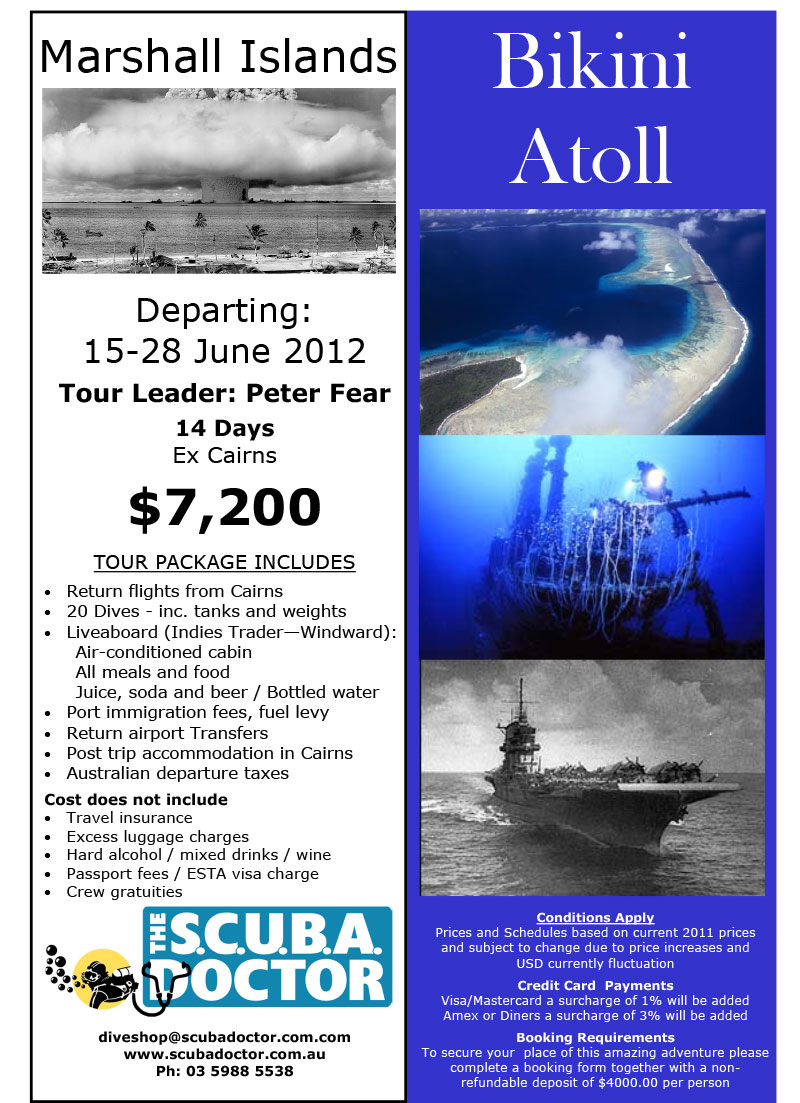
| Dive expedition organised through: The Scuba Doctor (Rye, Victoria) -- https://www.scubadoctor.com.au and Dive Adventures -- https://www.diveadventures.com.au Bikini Atoll is, without a doubt, the top wreck diving destination on the planet! Soon after I started diving back in 2006, I met Peter Fear, The Scuba Doctor, and began to hear stories from Peter and some of the others who had been with him on a dive expedition to Bikini Atoll in 2005, about just how great the place was. Some of the guys on that trip stopped diving for more than two years afterwards, saying, "What's the point? Nothing can top Bikini Atoll!" By the time Peter Fear returned from his second expedition to Bikini Atoll in 2007, I was salivating at the concept of diving the USS Saratoga (CV-3), an aircraft carrier and one of the world's largest "dive-able" wrecks. So I booked to go on the 2009 expedition and started to do the technical diving training to get the skills and certifications I'd need. Back then, around 250 or so divers a year got to go to this remote location in the Marshall Islands. The Bikini people had set up a land-based diving operation, and you could fly into Bikini Atoll via Majuro. An expedition spot costs more than $12,000 plus expenses for a 2-week trip per diver. Yet it was still a destination every serious wreck diver dreamed of getting to. Then, late in 2007, the operators cancelled diving at Bikini Atoll because they couldn't rely on the airline to get people in and out. Disaster! How was I ever going to fulfil my dream of diving on the sunken ghost warships of the nuclear fleet? Without a major lottery win or the ability to hook up with someone travelling there by boat, as Paul Allen, the co-founder of Microsoft, did on his luxury 126-metre mega-yacht "Octopus", it looked like I would never get to dive at Bikini Atoll. Then one Wednesday afternoon in October 2010, just a few weeks after returning from an expedition diving the British HMS Hermes aircraft carrier sunk by the Japanese in WWII off Batticolola, Sri Lanka, I got a call from Peter Fear saying, "There’s a boat leaving to go to Bikini Atoll on Sunday and there's a spot on it if you want it?" About 30 minutes later, my boss came into my office and asked why I was looking so depressed. I told him about the offer, and he said, "Go!" I then explained my work commitments for the next three weeks, and he said, "Don’t go!" So Peter Fear was off on his third trip to Bikini Atoll. This time, it was a trial liveaboard expedition on the Indies Trader Marine Adventures vessel. Martin Daley, the owner operator, had invited Peter Fear, plus Pete Mesley from New Zealand, along to offer their expertise on setting up the liveaboard dive operation. Within a few short weeks of diving on HMS Hermes (95), the world's first aircraft carrier, Peter was diving on the USS Saratoga again. Lucky bugger! There are only three aircraft carriers in the world where you can dive, and he got to dive two of them within a month of each other. (The third is the USS Oriskany (CV-34), sunk as an artificial reef, now popularly known as the "Great Carrier Reef," off the coast of Florida, USA.) The trial liveaboard diving expedition to Bikini Atoll was a great success, and Indies Trader Marine Adventures obtained the only license to dive Bikini and scheduled dive expeditions for 2011. I immediately booked to go on one with Peter, but had to cancel because of work. I then booked to go on The Scuba Doctor's expedition in February 2012, but again had to cancel due to work commitments. But, in October 2012, I finally made it to Bikini Atoll! THE JOURNEY Bikini Atoll is a remote place, situated in a lonely part of the world, just north of the equator in the Pacific Ocean, halfway between Australia and Hawaii. It's one of the 29 atolls and five islands that compose the Marshall Islands, and part of the geographic area referred to as Micronesia. I flew from my home in Melbourne to Cairns with Peter Fear (on his sixth trip to Bikini Atoll) on a Thursday morning, and we met up with two other Australian divers there — Fiona Edwards and Steve Crosling. Then, just after midnight on Friday, we continued onto Guam, where we met up with three other divers — Michael Cooper, Oliver Bourquin, and Emmanuel Raze — who'd flown in from Europe. But there was a problem. We were informed by the airline that a severe storm was battering Kwajalein Atoll, our departure point for the Indies Trader liveaboard vessel, MV Windward, and we might not be able to land there. We got on the next island hopper flight anyway, with the hope that we'd make it to Kwajalein. First stop, Chuuk Lagoon, and we waited to get an update from the airline captain. Not looking good. Then onto Pohnpei, where we were told the truth. There wasn't a storm. The USA were conducting missile testing at Kwajalein Atoll, and the airspace was closed! We continued to Kosrae and then bypassed Kwajalein, flying into Majuro. On Saturday morning, we joined five other divers — Bill Jakab, John Lundberg, Stephen Pahl, Warren Wisnewski, and James Wisnewski — who were travelling from the USA via Hawaii. We all took off for Kwajalein. Flying into an American Ballistic Missile testing base that is at "Code Alpha", where the Americans don't want visitors, was certainly an experience. Those guys are paranoid! By midday, we cleared customs and were escorted to the ferry terminal by US military officials, where Edward Maddison, the Bikinian dive master for the expedition, greeted us. Eventually, come late afternoon, we boarded an army ferry boat and headed for Ebeye Island, a short distance away. The MV Windward liveaboard was there to meet us. Chris Abrahams, the Aussie boat captain, and Peter Fear took us through the safety briefing and showed us around. This is a working boat, not a luxury liveaboard, and we'd be travelling to a very remote location and doing some deep (50–54 metres) technical diving and long run times. So we paid attention. Each of the twelve of us chose a bunk bed in the large, one-room, lower accommodation hold and then started to unpack and set up our kit on the dive deck. The shared accommodation is not a problem and is comfortable. However, if you're looking for your own cabin with an en-suite, this is not the boat for you. SCUBA DIVING AT BIKINI ATOLL Let’s face it, the magnitude of a dive expedition to Bikini Atoll isn't for everyone. First, there is the sheer isolation. You're aboard a 24 metre vessel for 14 or so days out at sea, 25 to 30 hours away from the nearest help, which is a USA missile testing base, and they don't want to know you. You can either enjoy the incredible freedom of having no cellphone or Internet service, or despair at being cut off from the world. However, if you go, you will get to experience what, without a shadow of a doubt, is the best wreck diving you will do in your diving career. Plus, you’re in water at a temperature of 30 degrees Centigrade, with 30 to 50 metres of visibility. Wow! You get to do two decompression dives per day, diving to a maximum depth of 45 to 55 metres. The two rebreather divers in our expedition party were typically doing run times of 2 to 3 hours. On open circuit, we were usually doing 70 to 100 minute run times and 20 to 30 minute bottom times, with a four to six hour surface interval in between dives. I dived with twin 300-bar, 12-litre steel cylinders filled to 250 bar with air, carrying an 11-litre aluminium cylinder with EAN50, and then using a 7-litre steel cylinder with EAN95 on the deco bar. While I used the EAN95 to accelerate my deco, when my dive computer cleared, just to be conservative, I still stayed in the water for the same time as the others who were not using EAN95. I'd spend my time on the deco bar going over in my mind the fantastic details of whichever warship we'd just explored. MV Windward is equipped with a 48-inch, twin lock chamber, deck hyperbaric decompression chamber, to provide safety for advanced remote location sport and technical diving. There is Nitrox, O2, Helium and Sorb, plus steel and aluminium twinsets, deco pony cylinders, etc. The expedition liveaboard MV Windward crew included: Chris Abrahams, the Aussie boat captain. Edward Maddison, the Bikinian dive master for the expedition. Brian Kirk, the engineer and dive master for the expedition. On two nights, the crew and expedition divers left MV Windward and joined the island maintenance crew at the Bikini Sunset Bar for a tropical beach BBQ. It just doesn't get any better than this. After our last dive at Bikini Atoll, it was time to wash down the dive kit and then stow everything securely for the long steam back to Kwajalein Atoll. We arrived back at Ebeye Island in the late afternoon and then had our last expedition dinner together, celebrating with ice cream bought on the island. See also: https://www.borrett.id.au/downloads/dive_article_diving_the_nuclear_fleet_at_bikini_atoll.pdf |
|||