


Logbook Scuba Dive # 364 - HIJMS Nagato
| Logbook Scuba Dive # 364 - HIJMS Nagato |
 Good
Good| Cylinder Set #1 | |||
| Cylinder Type: | Cylinder Size: | Working Pressure: | Supply Type: |
| Steel |  24 litres 24 litres |
300 bar |  Open Circuit (OC) Open Circuit (OC) |
| O2: | He: | Min. PPO2: | Max. PPO2: |
| 21% | 0% | - | 1.4 bar |
 EAN 21 EAN 21 |
MOD: | EAD: | END: |
| 56.6 m | 56.6 m | 56.6 m | |
| Start Pressure: | End Pressure: | Diff. Pressure: | |
| 252 bar | 74 bar | 178 bar | |
| Avg. Depth: | SAC Rate: | ||
| - | - | ||
| Cylinder Set #2 | |||
| Cylinder Type: | Cylinder Size: | Working Pressure: | Supply Type: |
| Alumimium |  11 litres 11 litres |
200 bar | Open Circuit (OC) |
| O2: | He: | Min. PPO2: | Max. PPO2: |
| 50% | 0% | 0.19 bar | 1.6 bar |
| EAN 50 |
MOD: | EAD: | END: |
| 22.0 m | 10.3 m | 22.0 m | |
| Start Pressure: | End Pressure: | Diff. Pressure: | |
| 200 bar | - | - | |
| Avg. Depth: | SAC Rate: | ||
| - | - | ||
| Cylinder Set #3 | |||
| Cylinder Type: | Cylinder Size: | Working Pressure: | Supply Type: |
| Steel | 7 litres |
232 bar | Open Circuit (OC) |
| O2: | He: | Min. PPO2: | Max. PPO2: |
| 95% | 0% | 0.19 bar | 1.6 bar |
| EAN 95 |
MOD: | EAD: | END: |
| 6.8 m | -8.9 m | 6.8 m | |
| Start Pressure: | End Pressure: | Diff. Pressure: | |
| 200 bar | - | - | |
| Avg. Depth: | SAC Rate: | ||
| - | - | ||
| Avg. Depth: | SAC Rate: | ||
| 22.59 m | 17.96 litres/min | ||
| Gas Mixture: | |||
| - | |||
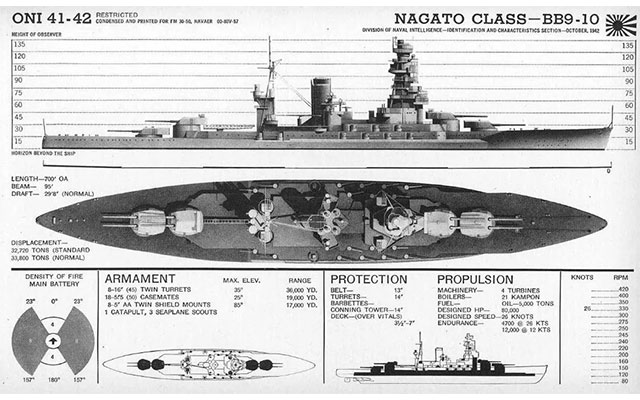
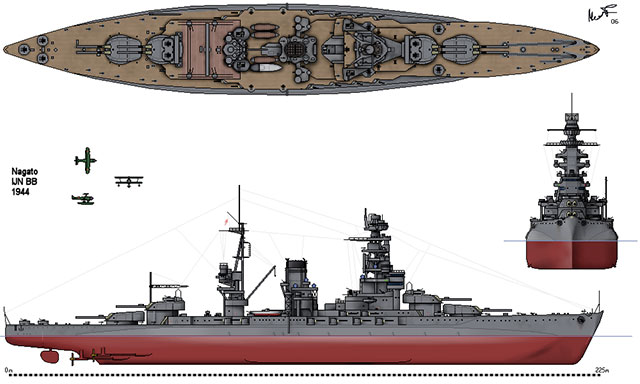
| IT'S A BATTLESHIP! On Wednesday morning, I was really excited as we headed out to dive the Japanese battleship HIJMS Nagato. She was launched in 1919 and, as the jewel of the Imperial Japanese Navy, was Admiral Isoroku Yamamoto's floating fortress flagship during Japan's World War II attack on Pearl Harbour. The steel-hulled vessel is 221 metres long, 34 metres wide, weighs 32,720 standard tons and is capable of doing 27 knots. She was the first battleship in the world to mount 410 mm (16-inch) guns on her deck. Some of you might have seen the huge shells for these guns on one of the sunken Japanese supply ships at Chuuk Lagoon. The Nagato survived the "Test Able" air blast on 1 July 1946, but eventually capsized and sank five days after the "Test Baker" underwater blast on 25 July 1946. She is upside down in 55 metres of water and is an incredible dive. We conducted a live boat drop from the MV Windward and headed down to the keel of the Nagato, continuing down the port side of the hull until the bridge came into view. It used to tower above the ocean's surface, some 30 metres high, but the bridge pagoda now sits perfectly placed along the sand to one side of the ship. We arrived at the exact spot where Admiral Isoroku Yamamoto gave the order "Climb Mount Niitaka" to initiate the attack on Pearl Harbour - a humbling experience. I have vivid memories journeying along the port side of the ship and under the hull in the darkness, seeing two imposing 410 mm guns coated in whispery lavender rope coral. Your body is simply dwarfed by the massive gun barrels. Then at the Nagato's stern, her four colossal screws and twin rudders appear like an underwater Stonehenge. It was a truly magnificent sight. Standard procedure for all dives was to return to the buoy line to which the support boat would be tied. It would deploy a line with a drop cylinder of EAN50 at 15 metres and another with EAN95 at 6 metres, plus a trapeze with bars at 9, 6 and 3 metres. MV Windward was live, retrieving surfacing divers after a radio call from the support boat. For dives on the Saratoga, MV Windward would tie up to a substantial bow mooring line and deploy the trapeze and drop line. |
|||
|

|
|||
|
|
| Field1 | |||
| - | |||
| Field2 | |||
| - | |||
| Field3 | |||
| - | |||
| Field4 | |||
| - | |||
| Field5 | |||
| - | |||
| Field6 | |||
| - | |||
| Field7 | |||
| - | |||
| Field8 | |||
| - | |||
| Field9 | |||
| - | |||
| Field10 | |||
| - |