


Chuuk Lagoon (Truk Lagoon) - Island
| Chuuk Lagoon (Truk Lagoon) - Island | |||
| Name: | Type: | ||
| Chuuk Lagoon (Truk Lagoon) | Island | ||
| Map: | |||
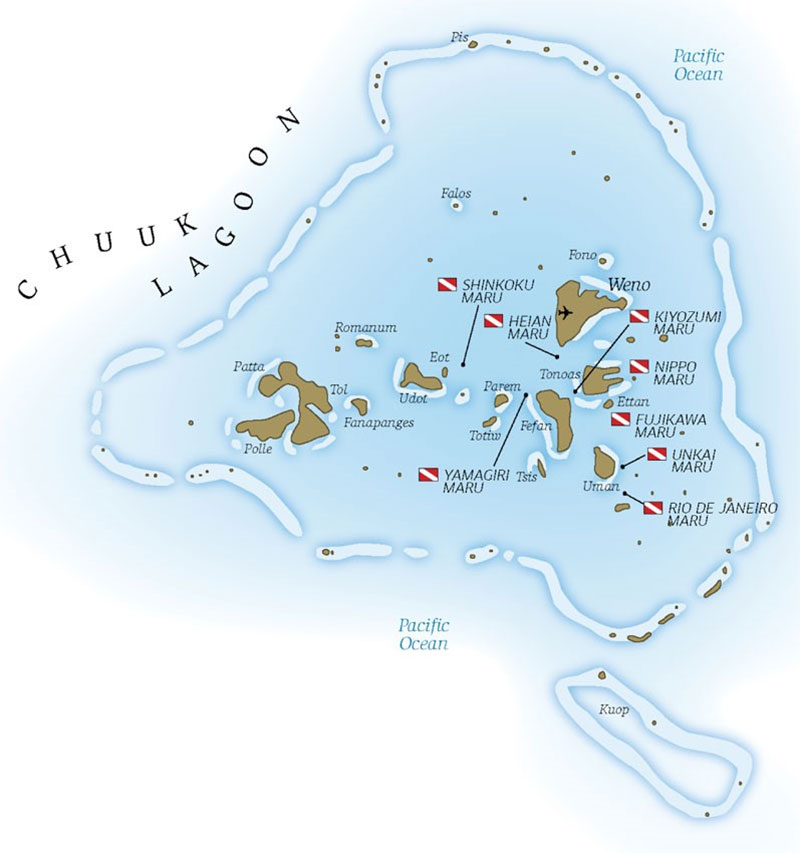 |
|||
| Comments: | |||
| SOME HISTORIC BACKGROUND FOR CHUUK (TRUK) LAGOON In 1920 the League of Nations handed over the Caroline, Marshall and Marianas islands to Japan as a reward for being on the winning side in World War I. While the Treaty of Versailles stated "... no military or naval bases shall be established in the territory," in a few years the Japanese started systematically breaking the treaty in preparation for their imperialistic designs on the greater Pacific region. The only honourable thing to do was to leave the League, which the Japanese did in 1934, immediately posting "No Trespassing" signs all over the region. One very prohibited area was Truk Lagoon in the eastern Carolines. After that 7 December 1941 day of infamy at Pearl Harbour, the Japanese Fourth Fleet established a command centre and anchorages at Truk. Soon they were joined by the Sixth Destroyer Flotilla, Seventh Submarine Flotilla and 17th Air Corps. In August 1942, Admiral Isoroko Yamamoto, the guy in charge of everything with a rising sun ensign, made Truk his headquarters. At one time 40,000 Japanese were stationed on the islands in the lagoon. They constructed more than 1,200 buildings, including a huge hospital, communications centres, barracks and repair shops. They also built fuel storage tanks, ammunition dumps, fortifications, anti-aircraft gun emplacements, seaplane and submarine bases, plus several deep water anchorages. All of these facilities, plus the presence of the Commander of the Combined Fleet, helped foster the belief that Truk was an impregnable fortress, a veritable Gibraltar of the Pacific. By early 1944, the U.S. and allied naval forces of Commander in Chief, U.S. Pacific Fleet, Admiral Chester Nimitz were well underway across the Pacific, systematically hitting one Japanese base after another. Task Force 58, one of the most powerful naval forces ever put together, commanded by Rear Admiral Marc Mitscher, had just devastated Kwajalein in the Marshall Islands. Looking at a map, you wouldn't have to be a genius to deduce that Truk's days were numbered. As if to confirm this, on 4 February 1944 a high flying, solitary B-24 was sent to take reconnaissance photos of Truk Lagoon. Once developed, these photos showed the anchorages crowded with all manner of warships and support craft. However, this over flight hadn't gone unnoticed. Admiral Koga, who'd taken over in April 1943 when Yamamoto's plane was shot down, put two and two together and had his big combat ships make way to Palau. Kogo himself, apparently figuring he could get a better perspective on everything from a distance, hopped aboard the giant battleship Musashi bound for Singapore. (He would die a month later in an air accident.) U.S. Rear Admiral Mitscher, his boss Vice-Admiral Raymond Spruance, and the other allied planners had heard all of that Gibraltar talk, so they ruled out an amphibious assault of Truk. Since there wasn't any land handy for land based aircraft, and since the Japanese fleet moorings were too far inside the lagoon for naval gunfire to reach them, they decided to try something unprecedented in the annals of naval warfare. An attack carried out solely by carrier based aircraft. Mitscher came prepared. His three task groups included the carriers Enterprise, Yorktown, Belleau Wood, Essex, Intrepid, Cabot, Bunker Hill, Monterey and Cowpens; the battleships North Carolina, Massachusetts, South Dakota, Alabama, Iowa and New Jersey; the cruisers Sante Fe, Mobile, Biloxi, Oakland, San Diego, San Francisco, Wichita, Baltimore, Minneapolis and New Orleans; plus assorted destroyers and submarines. Before sun-up on 17 February 1944 they were sitting about 145 kilometres (90 miles) from Truk, ready to launch Operation Hailstone. One after another 72 Hellcat fighters catapulted off the carrier decks with orders to destroy enemy aircraft and gain control of the skies over the lagoon. Then a second wave of 18 Dauntless dive bombers peppered the airfields with incendiaries and fragmentation bombs. Next came a wave of fighters, dive bombers and torpedo bombers bent on destroying every ship in the lagoon. Such was their enthusiasm for the task at hand that a number of pilots made a little more U.S. naval history, continuing their carrier operations right through the night. Meanwhile, Mitscher's battleships, cruisers and destroyers were patrolling nearby waters looking out for enemy shipping. And outside the two unmined reef passes, packs of submarines sat, waiting to surprise any Japanese ships favouring discretion over valour. Other subs stood by to pick up downed airmen. One, the Tang, did itself proud by fishing 22 crewmen out of the water, some from inside the lagoon. In reply, the Japanese didn't particularly distinguish themselves. They shot down some of the 26 planes lost by the U.S. And towards evening on the first day they launched seven Kate torpedo bombers, one of which managed a hit on Intrepid, killing 11 men, injuring 17 and sending the carrier to Majuro for repairs. This poor showing by the Japanese imperial forces was due in part to the quick destruction done to their airstrips, as well as a shortage of experienced pilots following the battles of the Coral Sea and Midway. But mainly it was the result of some pretty fuzzy strategic thinking. The Japanese command left the defence of this enormous, extremely important base to just a handful of troops and a mere 40 anti-aircraft guns. Sure they had their planes, but they weren't much use after the second wave. By the end of the second day, 30 waves of planes had flown 1250 sorties, unloading 400 tons of bombs and aerial torpedoes - 15 times the ordinance dropped by the Japanese at Pearl Harbour on 7 December 1941. They had destroyed 90% of the Japanese shore installations and all of the airfields. They put over 250 planes out of commission. Most importantly, they sank or crippled more than 30 major vessels, most notably the cruiser Naka, the auxiliary cruisers Aikoku Maru and Kiyosumi Maru, the destroyers Fumitsuki and Oite, the submarine tenders Rio de Janeiro Maru and Heian Maru, as well as six tankers and 17 freighters. So much for that Gibraltar of the Pacific myth! Finished for the time being, Task Force 58 steamed on to Guam, Tinian, Saipan and Eniwetok. A couple of months later, near the end of April 1944, they paid a return visit to Truk and added another 93 planes to their total, 59 in the air and 34 on the ground. This time 35 U.S. planes were lost. Subsequent attacks took place in May and June 1944. Not only did all this spectacular carnage go a long way towards ending the war in Pacific, it also created the all-time greatest collection of artificial reefs anywhere in the underwater world. It could have been a lot worse for the Japanese. Had the attack come a few days earlier, the Japanese Combined Fleet could have been reduced by an additional battleship, a couple of carriers, five or six heavy cruisers, two or more light cruisers, over a dozen destroyers and nearly that many submarines. LEARNING ABOUT CHUUK (TRUK) LAGOON I first read about the graveyard of sunken ships at Chuuk (Truk) Lagoon soon after I started scuba diving in 2006. As I progressed in my diving and became interested in wreck diving, the idea of all of those huge wrecks resting in clear, tropical waters at Chuuk Lagoon so intrigued me that I vowed to dive them one day. However, first came planning for a subsequently cancelled dive trip to Bikini Atoll in June 2009, and then a successful expedition to dive the HMS Hermes aircraft carrier off Sri Lanka in August 2010. Still, those who had been there kept telling me I just had to dive the wrecks at Chuuk Lagoon, so one day late last year I sat down with Peter Fear at The S.C.U.B.A. Doctor and we worked out a trip plan for 5 days of diving around my rather hectic work schedule. By the time it happened in early May 2011, there were 18 of us on the trip. With a visit to Truk finally looking like actually happening, I started doing a little research on Micronesia in general, and Chuuk Lagoon in particular. The books that I recommend you read are: - Hailstorm Over Truk Lagoon, by Klaus Lindemann - World War II Wrecks of the Truk Lagoon, by Dan E. Bailey - Ghost Fleet of the Truk Lagoon, by William H. Stewart The name 'Micronesia' couldn't be more descriptive. From the Greek, it means 'tiny islands'. The current accepted tally is that there are more than 2000 dots of land, totalling an area of something like 3,200 square kilometres, lying scattered across nearly eight million square kilometres of the Pacific in a hot, wet belt between the Equator and the Tropic of Cancer. Some are coral atolls, others sunken mountains. Some are flat and barren, others covered by lush rain forests. Some have sparkling beaches, others mangrove swamps. Still others feature rugged cliffs and crashing shorelines. Anthropologists believe most Micronesians came originally from the Malaysia area. Over the years they developed some regional differences, most obviously their languages - they speak nine with a variety of dialects; and their appearances - they traded genes with a series of Western colonisers. In the 18th century the Spanish decided to bring their God to the island folk. The zealous, pious efforts of the Spanish met with considerable success, and today about half of all Micronesians look to the Vatican for spiritual guidance. Following the Spanish-American War, Germany anxious both to become a colonial power and to take advantage of all the copra, bought the islands for 25 million pesetas. With the outbreak of the First World War, Japan moved in and seized everything they could get their hands on. Germany, having more pressing business elsewhere, withdrew without opposition. They left a legacy of increased production, expanded trade and disciplined administration. The Japanese brought progress. New roads, hospitals, cisterns, even a railroad system on Saipan to carry sugar to the docks. And, of course, they brought loads of fortifications. Next it was the turn of the United States or, more correctly, the United Nations. When World War II ended, the islands became a U.N. trust territory, administered first by the U.S. Navy then the U.S. Department of Interior. The yanks undertook to prepare the islanders for the time when they would take their place on the world scene. In accordance with the original intent of the trusteeship, the island groups began deciding their own fates. In 1977 the Northern Marianas became a commonwealth. Then the Marshalls and Palau Islands split away. And in June 1983 the Federated States of Micronesia, which included Truk, voted to end U.S. administration. They formed their own constitutional government on 10 May 1979, so becoming a sovereign state after independence was attained on 3 November 1986 under a Compact of Free Association with the United States. I suppose this leaves them free to associate with whomever they choose, or choose not to. Chuuk (Truk) is not an island; it's the most populated state in the Federated States of Micronesia, with some 55,000 people. Chuuk means mountain in the Chuukese language and was known mainly as Truk (a mispronunciation of Ruk), until 1990. Although the Chuuk state encompasses more than 100 separate atolls, none comes close to Chuuk Atoll and Lagoon in scope. North of New Guinea, it is located mid-ocean at 7 degrees North latitude. The atoll consists of a protective reef, 225 kilometres (140 miles) around, enclosing a natural harbour 79 by 50 kilometres (49 by 30 miles), with an area of 2,130 square kilometres (820 sq miles). It has a land area of 127.4 square kilometres (49.2 sq miles). The area consists of 11 major islands (corresponding to the 11 municipalities of Chuuk lagoon, which are Tol, Udot, Fala-Beguets, Romanum, and Eot of Faichuk group, and Moen, Fefan, Dublon, Uman, Param, and Tsis of Namoneas group) and 46 smaller ones within the lagoon, plus 41 on the fringing coral reef, and is known today as the Chuuk islands. Chuuk Lagoon would be something special to dive even without the impressive collection of historic wrecks. One of my main reasons for researching Chuuk was to find out about the weather conditions. No-one wants to go so far to dive during a rainy season. Reports conflicted somewhat as to the length of the wet at Chuuk, but basically it seems to run from June through September. Because of the lagoon's proximity to the Equator, the water temperature remains a pretty constant 30 degrees Celsius (86 degrees Fahrenheit) all year round. Visibility, mostly due to a proliferous planktonic population, is not as great of some tropical locations, but superb in comparison to typical Melbourne conditions. I'm told it averages from 12 to 18 metres (40 to 60 feet), improving from October to May when the winds pick up. Naturally, these same winds can also churn the surface. The water gets really choppy when the local trades occasionally hit 55 to 75 kph (30 to 40 knots). Sediment is another problem. The wrecks, especially their innards, are blanketed by a deep cover of fine brown silt. For these reasons it would be nice to pick a time to visit Chuuk Lagoon when the conditions were favourable, but the number of divers visiting minimal. The fewer fins stirring the silt the better. I simply didn't have that luxury, plus from what I saw, I'm not sure there is a 'quiet time' there anymore. See also: https://en.wikipedia.org/wiki/Chuuk_Lagoon |
|||
| Diving Activity at Chuuk Lagoon (Truk Lagoon) | |||
| 13 dive sites at this City / Island: | |||
| Fujikawa Maru | Heian Maru | Hoki Maru | Hoyo Maru | IJN Sutsuki - Patrol Boat 34 | Japanese Zero 2 | Kansho Maru | Nippo Maru | Rio De Janero Maru | San Francisco Maru | Sankisan Maru | Shinkoku Maru | Yamagiri Maru | |||
| 14 dives at this City / Island: | |||
| 321 | 322 | 323 | 324 | 325 | 326 | 327 | 328 | 329 | 330 | 331 | 332 | 333 | 334 | |||