


Dive Site - SS Coogee
| Dive Site - SS Coogee | |||
| Dive Location: | City / Island: | ||
| SS Coogee | The Heads, Bass Strait, VIC | ||
| Country: | Rating: | Max. Depth: | Difficulty: |
| Australia |  |
34 m | Advanced Open Water |
| Aquatic Name: | Water: | Altitude: | |
| - | Salt | 0 m | |
| GPS Latitude: | GPS Longitude: | GPS Datum: | |
| 38° 18.411′ S 38.30685° S 38° 18′ 24.66″ S |
144° 34.306′ E 144.571767° E 144° 34′ 18.36″ E |
Google Map | WGS84 |
| 6 dives at this location: | |||
| 18 | 107 | 146 | 168 | 337 | 354 | |||
| Map: | |||
 |
|||
| Comments: | |||
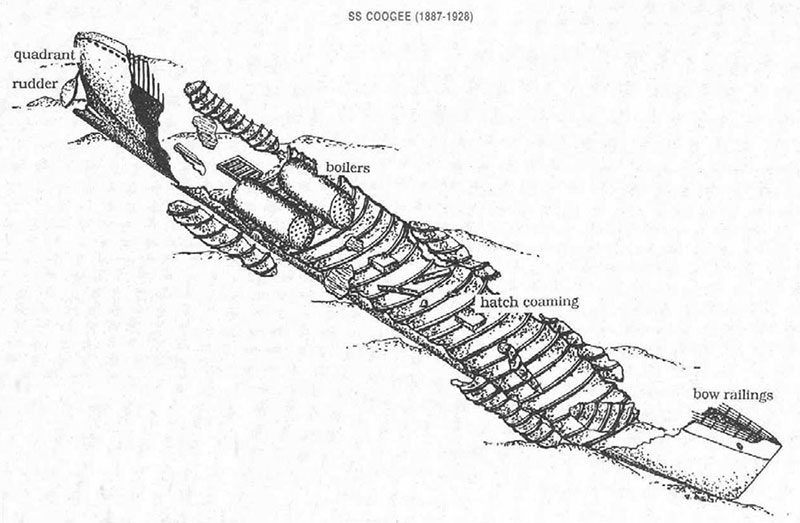
| The steamship SS Coogee (aka Lancashire Witch, Coogee, HMAS Coogee) was originally built to sail between Liverpool and the Isle of Man and was then known as the Lancashire Witch. When the ship's British owner became bankrupt in 1888, well known Melbourne ship owners Huddart Parker Ltd. bought the steamer to sail between Melbourne and Geelong. For 41 years, Coogee served on various routes. It also had a number of collisions, but was repaired and returned to service. In 1928, the steamer came to the end of its useful life and became uneconomic to maintain. It was stripped of fittings considered valuable and taken out through Port Phillip Heads. It was then blasted with explosives until it sank and settled on the seafloor. The SS Coogee shipwreck is historically significant for its working life in a variety of roles for nearly 40 years. The Coogee served as a Port Phillip passenger excursion steamer, Bass Strait passenger and cargo ship, cable repair ship, an armed patrol boat, and as a minesweeper during World War I. It is recreationally significant as one of the wrecks in the Victorian Ships' Graveyard and is a spectacular advanced deep dive. DIVING THE SS COOGEE SHIPWRECK The Coogee shipwreck lies approximately 4 km (2.49 mi) offshore between Point Lonsdale and Barwon Heads with its bow pointed towards shore (facing north) on a flat limestone and sand seabed. The bow rests on the sand at 33 m (108 ft) and the stern is at 35 m (115 ft) depth. The bow and stern are the most complete structures of the wreck as most of the midships section is flattened or missing — most likely due to the use of explosives to scuttle the ship. The Coogee is a truly beautiful wreck, parts of which are blanketed by yellow zoanthids, adding to its appeal and making it much loved by photographers. There are plenty of nooks and crannies to explore as you head from one end of the wreck to the other. Fish life abounds on the wreck and underneath the collapsed hull critters such as Giant Australian Cuttlefish, or even varied catsharks, can be found. The three main areas of interest are the bow, the boilers, and the stern. The bow of the Coogee is delightful with lovely, colourful growth, sponges and nice whips. It's easily recognisable, despite being on its side, and you can still see some of the original ship's railings. There always seems to be a prolific amount of life around this section of the wreck. The boilers are imposing and you can swim in between them for a bit of fun. Their sheer size is impressive and justifies a look. The engine bed can be seen amidships. Hatches can be seen in the middle of the ship on the centre line. The stern is very photogenic with the rudder gear protruding and everything thoroughly blanketed by yellow zoanthids. The steering quadrant, used to steer the rudder, is particularly popular with underwater photographers. There's even a little bit of penetration to be found and you can go under the stern and check out the rudder. There are some nice fans under the stern section to check out and usually a large-toothed beardy. In this area, divers will also be able to see the remains of the two decks. SS COOGEE SHIPWRECK HISTORY - Built in 1887 The Coogee was a three-masted iron screw steamer of gross tonnage of 762 tons, built in 1887, by J.L. Thompson & Sons, Sunderland, England. The overall length of the Coogee was approximately 225 ft (69 m), beam 30.3 ft (9.24 m) and draught 13.5 ft (4.11 m) with a displacement weight of 691 t (762 s-ton). The ship had an iron hull and four cemented bulkheads (watertight hull partitions) which made it less likely for the steamer to completely fill with water in the event of the hull being pierced in a collision. The steamer was propelled by a triple expansion engine capable of generating 250 HP. Its three cylinders had diameters of 23 inches (58 cm), 37 inches (94 cm) and 60 inches (152 cm) and with a cylinder stroke length of 36 inches (91 cm). The Coogee was of the awning deck type, built of mild steel, in accordance with Lloyd's rules for the 100 A1 class. She was additionally strengthened between decks by means of numterous web frames. The handsome deck house was constructed of teak, and she had accommodation for a large number of passengers in large and roomy state rooms, fitted in in luxurious style. She was launched 23 March 1887, and completed on 9 May 1887, as the Lancashire Witch for the New Isle of Man Steam Navigation Company for service between Liverpool and the Isle of Man. She was purchased by Huddart Parker in 1888 and renamed SS Coogee to operate in the Melbourne to Geelong trade in Port Phillip. When the ship sailed from England to Australia, it was rigged as a barque and its propeller was kept in the hold. After a brief period on this run, in 1890 she was placed in the Bass Strait passenger service, where she operated until 1904. SS COOGEE FATAL COLLISION - 25 December 1903 The Coogee left Launceston shortly before 5 p.m. on Christmas eve, 24 December 1903 with 30 passengers heading towards Melbourne on her 1,810th trip across Bass Strait. At 4 a.m. on Friday 25 December 1903, in a thick fog bank, the Coogee was involved in a collision with the Italian barque Fortunato Figari, which was bound for Newcastle. The sailing ship's bowsprit raked the Coogee's deck, flattening the mast, bridge and funnel. Captain Frederick Carring and Edward Jolly, the seaman at the wheel, who were on the bridge of the Coogee were killed. The deadly stroke was dealt by the jib-boom, a great spar 30 ft long and 3 ft in diameter of the Foriunato Figari. The funnel of the Coogee had been torn from its position and thrown on to the deck house over the saloon. The foremast had been lifted out of its socket, and was but dimly discernible amidst a confused mass of splintered wood, broken iron and tangled chains and ladders. The bridge had almost entirely disappeared, and all the boats on the starboard side had gone overboard. It was estimated they were between 50 and 60 miles off Cape Schanck. Beyond a big hole in her bows above the water line, where she had struck the Coogee's anchor, the Foriunato Figari was comparatively uninjured. The Fortunato Figari took the Coogee in tow. The first line parted, but the second held, and they set off on a course for The Heads. It was later found that the Coogee could make headway under easy steam and a course up Port Phillip was easily undertaken without assistance. The Coogee was held at fault. After repairs, the Coogee returned briefly to the Bass Strait passenger service before returning to the Melbourne to Geelong excursion route. SS COOGEE MULTI PURPOSE VESSEL The Coogee was requisitioned by the Royal Australian Navy, converted to be an armed patrol vessel and minesweeper, then commissioned by the Royal Australian Navy on 20 May 1918 as HMAS Coogee. She served during the later stages of the First World War as a minesweeper and armed patrol vessel in Bass Strait. She was returned as the SS Coogee to her owners in 1919, before being chartered by the Telegraph Department in 1921 to repair damage to the Bass Strait cable. The Coogee returned to the Port Phillip excursion trade but was eventually laid up. SS COOGEE SINKING Scuttled 27 February 1928 The Coogee was sold for scrap in 1927 and stripped by shipbreakers while she lay at 'Rotten Row'. Her engines were removed. She was scuttled outside Port Phillip in the Victorian Ships' Graveyard on Monday 27 February 1928 using explosive charges. Captain W. McBain, a former master of the steamer Coogee, was responsible for the scuttling. The tug Minah left Ann street pier, Williamstown at 1:30 a.m. and at daybreak the tug was off the West Channel pile light. The boatswain of the Minah, Tom Mooney, took the helm of the tug at 7 a.m. as the Minah passed into the West Channel. This was not his first experience of the sinking of a ship. He was helmsman of the Minah when the Buninyong was sunk in 1926, and in 1927 he guided the four J-class submarines, and the Malaita, to their resting places. The two vessels passed through the Port Philip Heads shortly after 8 a.m. Off Barwon Heads, at 9:30 a.m., the tow line was cast off. Three of the tug's crew then left in a rowing-boat to fire the charge that had been placed in the main shaft tunnel of the Coogee. A fresh southerly breeze sprung up and the Coogee began to set back towards The Heads. To prevent this, a line was fastened to her stern. Then the charge was fired. Water poured in through the open port holes, and the Coogee began to sink stern first. Big seas washed over her. Her funnel guys snapped, and the funnel tool a heavy list to port. Through an open hatch aft, water swept into the body of the doomed vessel. With a crash, the funnel then fell on to the deck. The Coogee rose about 30 ft by the head. One final shudder, and she sank into 20 fathoms, three miles south west from Point Lonsdale at midday. Location GPS coordinates from the book "Victoria's Ships' Graveyard" are known to be accurate. |
|||