


Dive Site - Hurricane
| Dive Site - Hurricane | |||
| Dive Location: | City / Island: | ||
| Hurricane | Port Phillip, VIC | ||
| Country: | Rating: | Max. Depth: | Difficulty: |
| Australia |  |
12 m | Open Water |
| Aquatic Name: | Water: | Altitude: | |
| - | Salt | 0 m | |
| GPS Latitude: | GPS Longitude: | GPS Datum: | |
| 38° 20.463′ S 38.34105° S 38° 20′ 27.78″ S |
144° 52.308′ E 144.8718° E 144° 52′ 18.48″ E |
Google Map | WGS84 |
| 1 dive at this location: | |||
| 385 | |||
| Map: | |||
 |
|||
| Comments: | |||
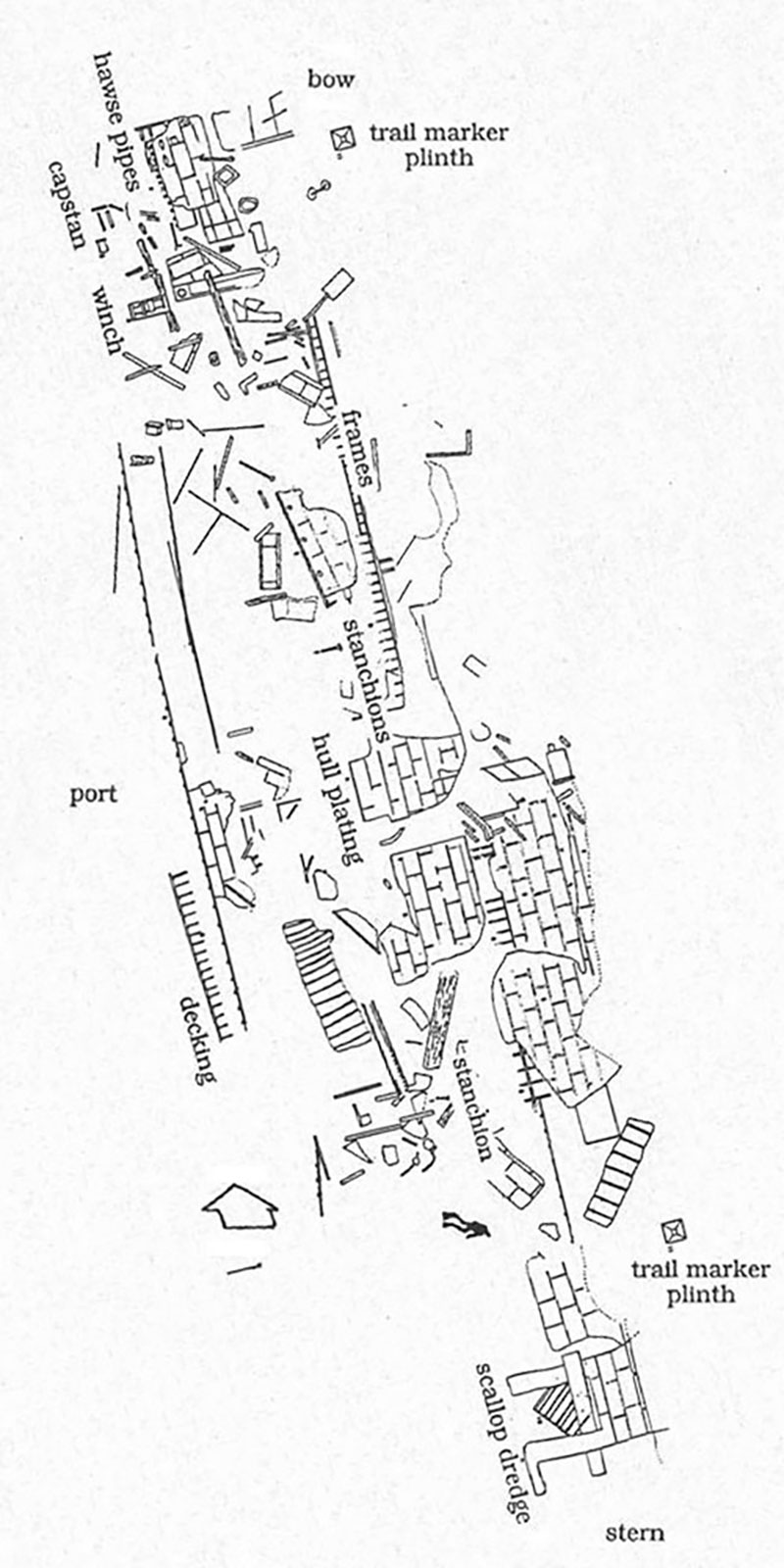
| The Hurricane was a three-masted, iron clipper ship with raised decks built in Scotland. She was one of the very first iron clippers to be built and also reported to be one of the fastest ships on the Australian run - completing the journey from England in around 80 to 90 days. She was designed to carry both passengers and cargo. She sank off Arthurs Seat in Capel Sound, Port Phillip, Victoria, on 22 April 1869. It's best to dive the Hurricane shipwreck at slack water. The remains of the Hurricane shipwreck lie in 9 m (30 ft) to 12 m (39 ft) of water offshore from Rosebud, in Capel Sound, Port Phillip. The shipwreck lies on a seabed of sand, silt and shells with its bow to the north on an axis of around 338 degrees true (NNW). When using a GPS unit and sounder to locate the shipwreck, it's best to approach from the east or west. The Hurricane shipwreck was relatively intact until the late 1960s when Ports and Harbours engineers considered it to be a navigational hazard and blasted it. The wreckage is spread over a large area, with the most prominent feature now the stern, which rises about 3 m (9.84 ft) out of the sand. The Hurricane shipwreck site is covered with steel plates, girders, and wooden beams. A small section of the stern stands off the seabed and is the most intact part of the ship. Near the bow, a large capstan is visible, amidst a complicated mass of twisted metal. An observant diver will notice star pickets protruding from the bottom. These were placed by the Victorian Archaeological Survey when it mapped the site. A concrete cairn outlining the history of the Hurricane has been placed near the stern. As with most shipwreck sites, the Hurricane forms an artificial reef, which is now home to many different species of fish including Dusky Morwong, Banded Morwong, Magpie Perch, Horseshoe Leatherjacket, Zebrafish, Senator Wrasse, Southern Maori Wrasse, Sixspine Leatherjacket, Longfin Pike (aka Yellowfin Pike), Snapper, Yellowtail Scad, Scalyfin, Bluespotted Goatfish, as well as other forms of marine life. This makes for an enjoyable dive and the keen diver can usually find a good number of Scallops close to the wreck. HISTORY The Hurricane was a three-masted iron clipper ship of ???, built in 1853, by Alexander Stephen & Sons Ltd in Front Yard 3 on the River Clyde, Kelvinhaugh, Scotland, and launched on 26 April 1853. The overall dimensions of the Hurricane were 214.9 ft (66 m) long, 30.7 ft (9.36 m) beam, and 20 ft (6.1 m) draught. Hurricane was an example of iron ship building at the height of fast record-breaking clipper technology. In fact the ship could make the journey between Liverpool and Melbourne in just 60 days. At the time, this was considered quite a feat. Hurricane had three iron masts and was designed with watertight compartments cemented throughout the ship. The ship was built with high bulwarks — the high wooden planking along the sides of a ship to prevent seas washing the deck and crew and passengers from falling or being washed overboard. Hurricane was also built with spar decking — raised decks, like narrow corridors above the upper decking. This enabled the crew to move across the ship during heavy seas to handle the rigging without the risk of being washed overboard. A newspaper item published just after the ship was built described Hurricane as, "well calculated for sailing, stability and stowage and altogether a finer specimen of iron ship was never launched". The Hurricane was built to transport cargo and take passengers on the Australian run and owned by W. & J. Lockett and registered in Liverpool. It was considered a safe, modern ship for its time. On its first return voyage, it carried gold exports from Melbourne to London. Hurricane carried cargo to supply the growing settlements of Port Phillip and country Victoria. On its final voyage its cargo included canary seed, whiskey, malt, bottled beer, glassware, caustic soda, saddlery, wire, nails, leather and blankets. On its return voyages, it usually took a cargo of wool, wheat, gold, mutton and beef and passengers retuning to England. Accommodation on board the Hurricane for paying passengers was supposedly quite luxurious and was said to be "unsurpassed by any ship in harbour". Intending passengers were invites to inspect the facilities. SINKING The Hurricane sank off Arthur's Seat in Capel Sound on Thursday, 22 April 1869. On its final voyage, the Hurricane left Liverpool, on 12 January 1869, under the command of Captain D. H. Johnston, with 27 crew, 19 passengers, and 2,000 tons of general cargo, consisting mainly of slates, chemicals, bottled and barrelled beer, bottled and barrelled spirits, bottled and barrelled wine, earthenware, iron products, wire, machinery hardware, household items and haberdashery. After a protracted voyage due to experiencing contrary winds, the Hurricane arrived at Port Phillip Heads on Wednesday 21 April 1869, and took on board Pilot Kennedy. However, owing to unfavourable winds, the Hurricane did not attempt to enter Port Phillip until daylight the next day. As the Hurricane entered The Heads on Thursday 22 April 1869, it scraped the bottom twice near Point Lonsdale, but due to the slight nature of the bump nothing more was thought of the incident, other than to have the carpenter sound the pumps, which indicated no water had entered. The Hurricane hove to off Queenscliff to be cleared by the health officer, which was duly completed and then resumed its voyage up the South Channel. Whilst proceeding up the channel it was reported that the fore compartment was being filled by water coming through the hawse holes, a not uncommon occurrence for the vessel. Shortly after it was noticed that the ship was dropping by the head. Six feet of water was found in the forehold. The pilot decided to head for Capel Sound, where the vessel could be anchored and then pumped dry, but time would not allow this to happen. The sail was shortened, and after rounding up the starboard anchor was let go, as the Hurricane sank by the head. Passengers and crew escaped into the rigging as the boats were lowered and crew and passengers put into them. The plight of the Hurricane was observed from Queenscliff and the tug Titan anchored there, was immediately despatched to render assistance. The Titan arrived shortly after the vessel sank and took off all the passengers and crew and proceeded up the bay to Melbourne. So quick was the foundering of the vessel that all on board lost everything, only saving what they stood up in. Within days, tenders were called to remove all the cargo and fittings from the wreck and J. Nicol and Co. were the successful with a bid to remove the cargo at one pound eighteen shillings a ton. Work began immediately, with divers successfully removing most of the cargo except for the slate, some iron and lumber. In the 1870s, a green wreck buoy warned sailors of the wreck's presence. In the 1960s, the wreck was considered a hazard to shipping and blasted with explosives. The Hurricane lay on the bottom of Port Phillip and was rediscovered by divers in March 1971, badly damaged and breaking up due to the ravages of time and explosives. Location: The GPS marks used for the Hurricane are taken from the book "Shipwrecks Around Port Phillip Heads" and are verified. |
|||