


Dive Site - Rotomahana
| Dive Site - Rotomahana | |||
| Dive Location: | City / Island: | ||
| Rotomahana | The Heads, Bass Strait, VIC | ||
| Country: | Rating: | Max. Depth: | Difficulty: |
| Australia |  |
39 m | Advanced Open Water plus Deep |
| Aquatic Name: | Water: | Altitude: | |
| - | Salt | 0 m | |
| GPS Latitude: | GPS Longitude: | GPS Datum: | |
| 38° 19.191′ S 38.31985° S 38° 19′ 11.46″ S |
144° 32.167′ E 144.536117° E 144° 32′ 10.02″ E |
Google Map | WGS84 |
| 2 dives at this location: | |||
| 87 | 280 | |||
| Map: | |||
 |
|||
| Comments: | |||
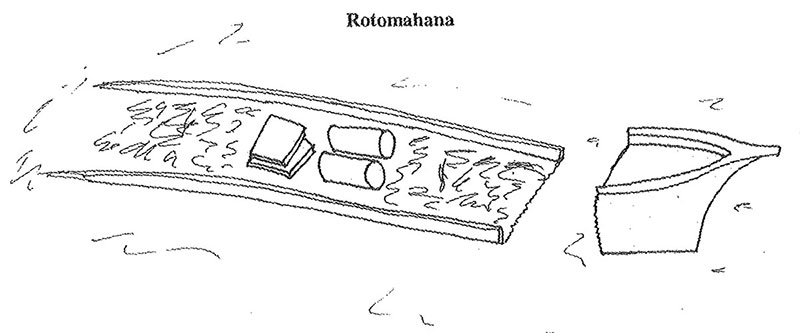
| The Rotomahana (aka SS Rotomahana) was used in the trans-Tasman service and later as a Bass Strait ferry. Said to be the first steel-hulled steamer in the world, she had a clipper bow and graceful hull. She served for many years on the Melbourne to New Zealand routes and was known as the "Greyhound of the Pacific" due to her great speed. The Rotomahana shipwreck lies on a sandy bottom, 39 metres deep, in the Victorian Ships' Graveyard, outside Port Phillip in Bass Strait. This is a dive for experienced deep/technical divers. DIVING THE ROTOMAHANA SHIPWRECK The Rotomahana shipwreck site lies in 39 metres of water with the bow pointing roughly to the east. There are four large condensers and/or two boilers amidships sitting side by side. The large clipper bow, which is separated from the rest of the hull, lies intact over on its port side, slightly to the port of the centreline. An area of broken hull structure reaches to boilers amidships, behind which is the remains of a formerly intact deckhouse, which used to be penetrable before it collapsed. The hull and remaining structure from here on is flattened and gradually disappears into the sand. The hull is badly broken up although there are plenty of steel girders and other debris including the old bowsprit. Several anchors and winches can also be seen. Some penetration is possible between and underneath the boilers of the shipwreck. Large schools of fish patrol the wreck. RITOMAHANA SHIPWRECK HISTORY — Built in 1879 The Rotomahana was a 1,777 ton steel steamer, built in 1879, by William Denny and Brothers in Dumbarton, Scotland. Built for the Union Steamship Co. of New Zealand, it had 4 cemented bulkheads, two decks and a single screw. The overall length of the vessel was approximately 90.89 m (298 ft), beam 10.73 m (35 ft) and draught 7.22 m (24 ft) giving a displacement weight of 1,777 t (1,959 s-ton). ROTOMAHANA LAST VOYAGE AND SINKING — Scuttled 29 May 1928 The Rotomahana was laid up in 1921, purchased by a Melbourne ship breaker in 1925 and slowly stripped of valuables. Once the pride of the Australian coast, the fastest ship in these waters, with a mysterious turn of speed, the holder for many years of the proud title "Ocean Greyhound," and designed as a private yacht for a prince, the old ship Rotomahana made her last passage on Tuesday 29 May 1928. She went to join her sisters, the Buninyong, the Coogee and the Courier at the bottom of the Bass Strait, after half a century's faithful service in Australian waters. Her fanciful title of "Greyhound" was earned by her then, prodigious speed of 15 knots, but on her final voyage she lumbered down Port Phillip in tow of the tug Minah, under the command of Captain McBain, at five knots. Formerly she was equipped with luxurious fittings, but then she was a decrepit and empty shell. A figurehead no longer distinguished her: the panels in the saloon, carved by hand from bird's-eye maple, had been taken from her; the old time notices in the steerage requesting passengers to remove their boots before getting into bed had been removed. Her lead piping, her superstructure, her 14,000 super feet of pine decking, her teak-railings, her funnel, her boilers — all had been taken out of her and only the shell of the old ship set forth in the ghostly light of the morning in tow of the Minah. It was her last voyage in the waters which her keel had ploughed for many a year. Few people were on the Railway Pier to see the cortege set out from Port Melbourne at 2 a.m. on 29 May 1928. A line splashed into the water, the Minah's propeller churned the surface and soon the old Rotomahana moved gently off down Port Phillip. She was said to be the first steel steamer ever built. On her trials, she made over 15 knots, but at sea attained 17 knots on occasion. The Minah and the Rotomahana passed through Port Phillip Heads at 11 a.m. J Larkin, a marine surveyor, then boarded the Minah and piloted the tug to the sinking place three and a half miles south-west of Port Phillip Heads. The pilot steamer Victoria, with the chief sea pilot Captain Palmer in command, accompanied the Rotomahana from Queenscliff and was present at the sinking ceremony. The gelignite charge, placed amidships in the engine room, was fired. A signal honour was paid to the old vessel when the international pilot flag (a St. George's cross on a white background) was dipped while she was sinking. Three active members of the pilot service were former captains of the Rotomahana. Just 25 minutes later nothing was to be seen of the once popular steamer but a few floating spars. She sank on an even keel into 20 fathoms of water in Victorian Ships' Graveyard. Location GPS coordinates from the book "Victoria's Ships' Graveyard" are GPS verified. |
|||